Instead, roughly 80 residents showed up to Daniel Webster Middle School to give voice to their anger about the Mayor's plan to increase rush hour traffic flow on their local boulevards. The plan calls for eliminating parking, and improving traffic signal timing to add capacity during peak periods. Those testifying were more restrained
than at the boisterous city council hearing back in December, but the anger was just as real. It should also be noted that while the Mayor sent a representative and
LADOT General Manager Rita Robinson that neither he nor Councilman Weiss were present this evening.
The community's arguments/concerns could be broken down to 4 categories: "Don't Take My Parking," "The Phases Are Out of Order," "The New Pico Will Be Less Safe" and "Is Any of This a Good Idea Anyway."
Don't Take My Parking
The Pico-Olympic Plan is broken down into three phases. Ironically it's the first phase, removing peak hour parking to add an extra lane of traffic, that is the most controversial.
The businesses along Pico claim to be reliant on the rush hour parking to remain profitable. Estimates varied on how much business would lose (one business owner noted that reducing parking along Wilshire Boulevard to create a bus only lane reduced revenue by 20-30% to local businesses,) and business owners seemed less than placated by a DOT handout that the change would only have "initial adverse impacts to parking availability," and that "customers can adjust to the new parking restrictions as has occurred elsewhere in the city."
Sherman Jahan, owner of Pico Cleaners, argued that 90% of his business comes in during morning rush hour (to drop clothes off) and evening rush hour (to pick them up.) He also noted that when he temporarily lost street parking after the earthquake, his business never got lost customers back and he had to close one of his stores. Jahan also noted that morning and evening rush hour are when many residents in the predominantly Jewish neighborhoods go to Temple (located directly on Pico Street) and removing parking will inhibit their ability to attend religious services locally.
Actually, every speaker except one testified about the cost to the community and businesses of losing the parking along Pico Boulevard in some form or another. Much of the concern comes from the lack of parking in the neighborhoods surrounding these corridors. Thus the argument goes, if you take away their street parking, you eventually take away the businesses. If you take away the businesses and speed up the traffic flow...well, then you're just turning these boulevards into a mini-highway.
The other two phases are improving directional signalization (a two day experiment with better signal timing along Pico Boulevard yielded a 45% "more efficient" commute) and "peak directional flow" where the adjacent lane to the "preferred" lane is changed to a peak lane. In layman’s terms, one westbound lane on Pico would be made an eastbound lane and the opposite would happen on Olympic. The total cost of the project is relatively low; $2.1 million would cover all three phases of the project. Currently, LADOT is asking for only $600,000 to pay for Phase I and Phase II.
The Phases Are Out of Order
Residents also repeatedly asked why move forward with this plan in its entirety instead of just fixing the signalization at the intersections. In a pilot of the program last fall, LADOT found that it could improve traffic flow by 45% by just updating the signal timing.
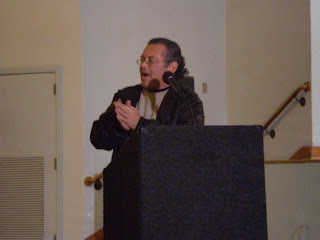
"You say in your own report that you can add 6 miles per hour with better timing of the lights…that sounds like a significant impact to me. It’s unfair to them (businesses on
Pico) to hurt their business without exhausting the traditional means," said Al
Casas, chair of the West LA Neighborhood Council Transportation Committee.
Husting repeatedly responded that there's only so much you can do with signalization, and that the total effect of re-timing the signals wasn't what they were aiming for. After the Q+A was over he told me that during their October trial, there were bottlenecks in many of the areas that currently have parking, and that's why the parking restrictions have to go first.
The New Pico Will Be Less Safe
Another concern is the impact these changes would have on pedestrians along the boulevards. By increasing the speed and volume of rush hour traffic, both roads will become less pedestrian friendly and could provide barriers that would make the road virtually impassible, forcibly separating communities.
Faster traffic is also a greater hazard to pedestrians. LADOT claims that the signals will be timed to keep traffic from going faster than 35 miles per hour, a sort of traffic calming through signal timing plan. "These lights will be timed, if you go 40 miles per hour, you’re going to end up sitting at a red light," said Husting "We’re not encouraging speeding traffic along these arterials."
But Avi Schonwald, president of A.V.I. Enterprises, argues that the street really doesn't need any more speed, "Pico already moved very fast in the evening. People barely have time to park safely." After the meeting he told me that faster traffic will be a hazard to the Orthodox Jewish community in the area when they walk to weekend services during Friday night rush hour.
Is Any of This a Good Idea Anyway

Lastly, there are concerns that this plan would make traffic even worse than it currently is.
Tom Donovan, Chair of the West LA Neighborhood Council Planning Committee wondered whether or not this plan would
induce demand in development density, noting that "trying to fix congestion by increasing capacity is like trying to cure obesity by loosening your belt.
Husting admitted that they don't know the full amount of traffic that will be induced or what impact the project will have on development standards, "We don’t know whether 5 miles an hour would effect developers decisions."
There were also concerns about whether or not the plan would induce more cut through traffic. LADOT claims that drivers will be less likely to use local streets for cut-throughs if the arterial roads work better. Some residents seem unconvinced, twice interrupting Husting with shouted objections while he explained this position.
LACBC Board Member Kent Strumpell brought an entirely different take to the debate. After complimenting LADOT for thinking outside the box, he painted a transportation vision that was probably more outside the box than anything else discussed in the room.
"This solution is all about the automobile. Cities are beginning to think of roads in a different way...we should look at a way to bring a complete streets solution to revitalize the area and reduce congestion."
When pressed by Councilman Bill Rosendahl, the evening's host and emcee, to tell the crowd what a "complete street" would look like, Strumpell explained that a complete street is "deisnged for all users and features inviting pedestrian environments, enhanced transit stops and facilities, bike lanes creating a beautiful area." Basically, Strumpell's vision, greeted by applause, was the exact opposite of the city's plan.
Next Steps for the Project
Councilman Bill
Rosendahl, claims neutrality over what the plan should look like although he is enthused by any thinking outside the box on this issue and was doubly enthused by the turnout and testimony at this event. "This town hall tonight is my effort to bring together the Mar Vista neighborhood council, the West LA neighborhood council and my (local and
appointedby the Councilman) empowerment Congress," said the Councilman.
The next step for the project will be next week when Councilman Jack Weiss holds his own community forum (more details on that later in the week.) LADOT will be releasing a report on the parking impacts, and a second community meeting for the City Council Transportation Committee, which could vote on the entire proposal as soon as next month. If the plan continues to move forward on an accelerated time schedule, the changes could be in place as early as this spring; however LADOT has promised to come back to the community with any changes before moving any new positions forward.


